
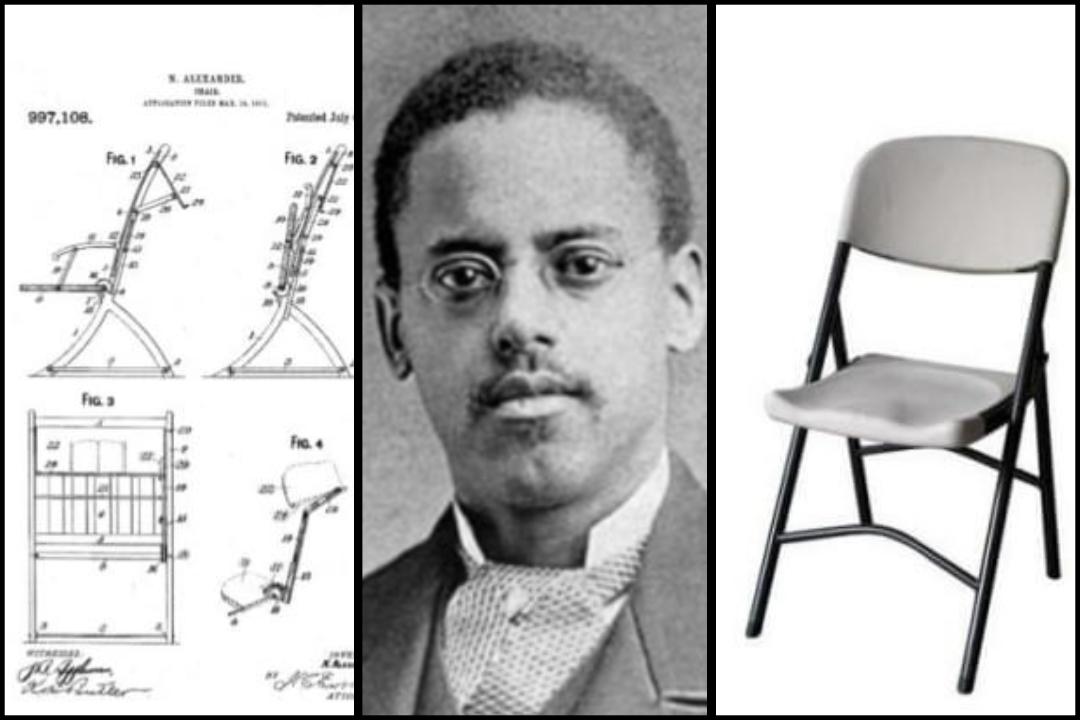
As we celebrate Black History Month, it is essential to recognize the many Black innovators whose ideas have quietly shaped everyday life. One such innovator is Nathaniel Alexander, the African American inventor credited with patenting an early version of the folding chair—an invention that not only transformed seating and space-saving design, but has also, over time, taken on unexpected cultural symbolism in moments of Black resistance and solidarity.
A Visionary Inventor in the Early 20th Century
Nathaniel Alexander was a Black inventor and educator who lived during a period when African Americans faced severe restrictions on education, employment, and economic opportunity. Despite these barriers, Alexander focused on creating practical solutions that improved daily living.
On July 7, 1911, Alexander was granted U.S. Patent No. 997,108 for an improved folding chair design. His model emphasized portability and efficiency, allowing the chair to fold compactly for easy storage—an innovation that proved especially useful for schools, churches, community centers, and meeting halls.
Innovation Rooted in Community Needs
Alexander’s folding chair featured a hinged seat and backrest, along with a book rest attached to the rear of the chair. This small but thoughtful addition reflected his connection to education and his understanding of how learning spaces functioned. The design helped maximize limited space while offering comfort and practicality.
More than a century later, the core principles of Alexander’s design remain visible in modern folding chairs used around the world.
From Practical Invention to Cultural Symbol
In August 2023, the folding chair unexpectedly re-entered the national spotlight during the widely publicized Montgomery Riverfront brawl in Montgomery, Alabama. A chaotic altercation broke out after a Black riverboat co-captain was assaulted while attempting to enforce docking rules. As bystanders stepped in to defend him, one individual was seen wielding a folding chair in an act that quickly became one of the most talked-about images from the incident.
Across social media, the folding chair transformed almost instantly into a symbol of collective defense, resistance, and solidarity. Memes, artwork, and merchandise flooded the internet, reframing the moment as an expression of standing up against injustice rather than mere spectacle.
Across social media, the folding chair transformed almost instantly into a symbol of collective defense, resistance, and solidarity. Memes, artwork, and merchandise flooded the internet, reframing the moment as an expression of standing up against injustice rather than mere spectacle.
A Legacy That Spans Generations
Nathaniel Alexander likely could not have imagined that his folding chair would one day hold cultural significance beyond its original purpose. Yet this moment underscores how Black innovation continues to echo across time—sometimes in ways that intersect with history, protest, and cultural expression.
Alexander’s legacy is not only found in furniture design, but in the broader story of Black ingenuity: creating tools, systems, and solutions that support everyday life and, at times, become woven into powerful historical moments.
Honoring the Past, Understanding the Present
As we observe Black History Month, Nathaniel Alexander’s story reminds us that Black history is not confined to textbooks—it lives in our homes, our public spaces, and even in the objects we use without a second thought.
The folding chair stands as both a testament to Black creativity and a modern symbol of resilience. From classrooms and churches to a defining viral moment in Montgomery, Nathaniel Alexander’s invention continues to carry meaning, purpose, and power.